Explore our OEM manufacturing catalog featuring engineered modular container homes, commercial units, and eco-friendly prefabricated structural modules manufactured in ISO-certified facilities.
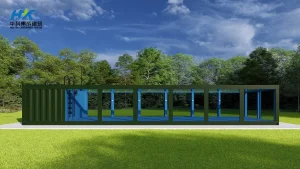
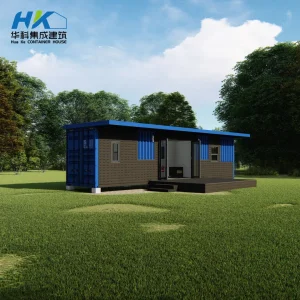
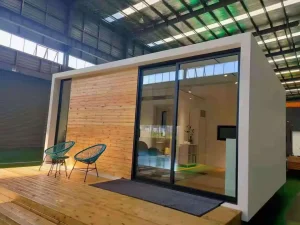
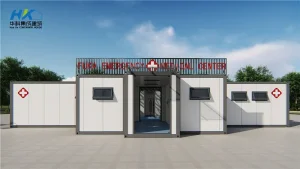
The architecture, engineering, and construction (AEC) industry stands at a critical structural tipping point. Historically responsible for nearly 39% of global energy-related carbon emissions—with 28% stemming from operational building energy and 11% directly attributed to embodied carbon in materials such as concrete, virgin steel, and glass—the sector faces unprecedented regulatory pressure, climate risk, and raw material volatility.
As sovereign nations enact stringent net-zero mandates (including the EU’s Energy Performance of Buildings Directive [EPBD], the US Inflation Reduction Act tax credits for low-carbon structural assemblies, and Australia’s NCC 2022 energy efficiency frameworks), international developers and institutional procurement leads are aggressively transitioning toward OEM Off-Site Modular Prefabrication (OSMC).
By shifting material assembly from fragmented job sites to automated manufacturing plants, OEMs control the Life Cycle Assessment (LCA) from cradle-to-gate. Utilizing high-strength Corten-A SPA-H structural steel frames drastically reduces structural mass while boosting tensile durability, yielding significant net carbon savings.
Modern modular units act as "material banks." Cold-formed light-gauge steel framing and standardized sandwich panel envelopes permit full deconstruction, relocation, or complete metallurgical recycling at end-of-life—eliminating landfill disposal costs and structural devaluation.
Global B2B buyers require detailed Environmental Product Declarations (EPDs). OEM suppliers engineered with ISO 14001 certification provide verifiable carbon metrics required for LEED Gold/Platinum, BREEAM Outstanding, and DGNB Platinum green building certifications.
Achieving whitepaper-level performance requires precise material science and tight industrial tolerances. As an enterprise-grade OEM manufacturer, our production framework integrates robotic welding, automated roll-forming, closed-cell insulation injection, and multi-layer corrosion mitigation.
| Structural Subsystem | Material Specification | Engineering Performance Index | Sustainability Impact |
|---|---|---|---|
| Main Structural Chassis | Corten-A SPA-H Atmospheric Corrosion Steel (ISO 630-5) | Yield Strength $\ge 355\text{ MPa}$, Tensile $\ge 490\text{ MPa}$ | 100% Recyclable; 50+ year anti-corrosion structural lifespan. |
| Thermal Core Insulation | High-Density PIR / PUR / Rock Wool Sandwich Panels | Thermal Conductivity $\lambda \le 0.020 - 0.024\text{ W/m}\cdot\text{K}$ | Zero ODP/GWP blowing agents; class A fire resistance (EN 13501-1). |
| Façade & Exterior Envelope | Fluorocarbon (PVDF) Coated Aluminum / Fiber Cement | UV Resistance ASTM G154; Wind Load $\ge 2.5\text{ kN/m}^2$ | Maintenance-free color fastness over 25 years; zero VOC emissions. |
| Fenestration Systems | Thermal-Break Aluminum Frames with Low-E Argon Double Glass | Overall U-value $\le 1.1\text{ W/m}^2\cdot\text{K}$, SHGC $\le 0.28$ | Reduces HVAC energy demands by up to 42% in tropical/arctic zones. |
| Internal Floor Matrix | Fiber-Cement Board + SPC Waterproof Flooring | Bending Strength $\ge 16\text{ MPa}$; Formaldehyde Grade E0 | Eradicates timber consumption; 100% moisture & termite resistant. |
A primary engineering challenge in metallic container structures is thermal bridging. OEM specifications incorporate continuous structural isolators (aerogel thermal breaks and elastomeric gaskets) separating outer Corten steel frames from interior living quarters, preventing condensation and mold while retaining strict R-values (R-30 to R-45).
Using parametric Autodesk Revit and Tekla structures, our engineering office outputs 100% precise production-line CNC instructions. Millimeter-level precision minimizes steel off-cut waste to under 1.5%, while guaranteeing seamless on-site stacked connection fit-outs.
The future of sustainable construction lies at the intersection of material chemistry, off-grid autonomy, and robotic manufacturing automation. Our OEM technology roadmap outlines four transformative milestones driving our production lines forward over the coming decade.
Direct factory integration of Building-Integrated Photovoltaics (BIPV) onto modular roofs and standing-seam wall panels. Generating clean solar energy directly from the envelope transforms structures into Net-Zero Energy Buildings (NZEB).
Replacing standard synthetic foams with bio-polyols derived from agricultural waste and ultra-thin aerogel blankets, achieving R-50 thermal insulation values within 50mm wall profiles.
Embedding RFID and blockchain material passports into every structural frame. Project owners can trace exact metallurgical origins, carbon footprints, and disassembly guidelines at end-of-life.
Deploying integrated solid-state battery storage and atmospheric water generators inside equipment shelters and modular cabins, providing complete infrastructure independence in extreme environments.
Modular building technology is not a "one-size-fits-all" commodity. Our OEM manufacturing capabilities adapt structural specs to geographically diverse climate challenges, building codes, and operational demands.
Climate Challenge: Extreme desert heat ($>50^\circ\text{C}$) or sub-zero arctic tundra ($-40^\circ\text{C}$).
OEM Solution: Fast-assembly heavy-duty flat-pack labor camps equipped with 100mm PIR core sandwich panels, heavy-load floor chassis, and central HVAC duct integration, deployed in record time for workforce deployment.
Operational Challenge: Immediate deployment of medical-grade isolated facilities.
OEM Solution: Prefabricated medical cabins featuring negative-pressure ventilation, washable anti-bacterial PVC floors, pre-installed medical gas channels, and rapid inter-module corridor connectivity.
Environmental Challenge: Zero ecological impact on protected natural sites.
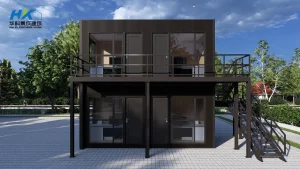
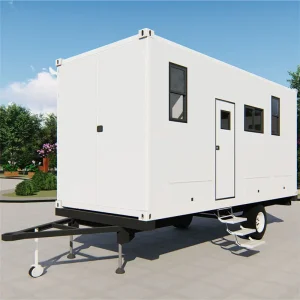
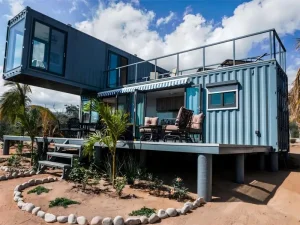
OEM Solution: Cantilevered container villas and fiberglass caravans mounted on elevated screw-pile foundations, preserving native flora while offering panoramic double-glazed floor-to-ceiling vistas.
Technical Challenge: Electromagnetic shielding, fire containment, and equipment protection.
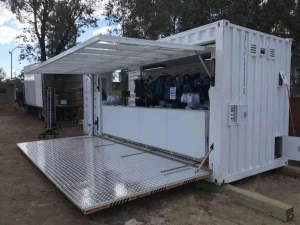
OEM Solution: Sealed equipment shelters built with non-combustible rock-wool core panels, IP65 weatherproofing, cable entry transits, and integrated fire suppression system supports.
Additional factory-direct modular structures customized to exact enterprise client parameters, ready for seamless global export.
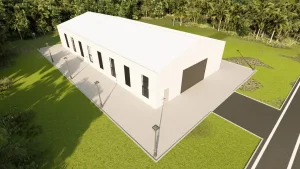
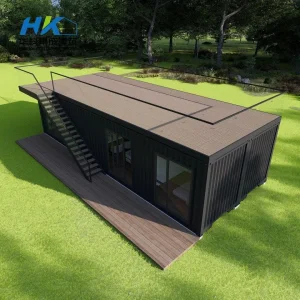
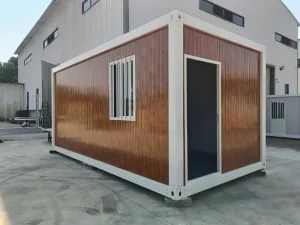
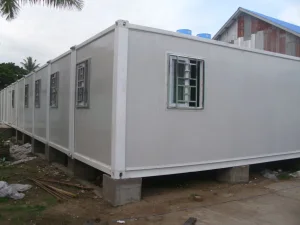
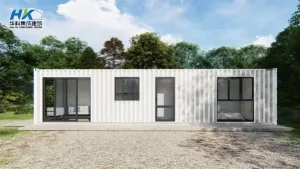
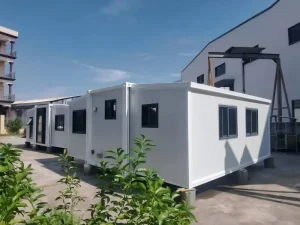
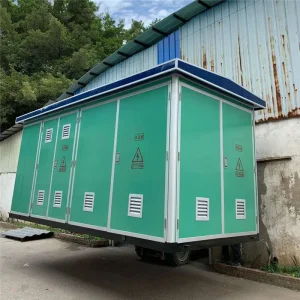
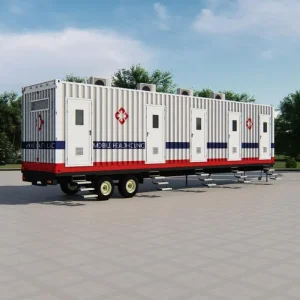
To assist industrial buyers and structural engineers in technical evaluation, the following matrix compares factory-controlled OEM modular construction against traditional reinforced concrete and heavy mass timber construction.
| Evaluation Parameter | OEM Modular Steel Structure | Mass Timber (CLT) | Reinforced Concrete (Site-Cast) |
|---|---|---|---|
| Construction Speed | Ultra-Fast (50–70% reduction) | Moderate (20–30% reduction) | Standard baseline (Slow) |
| Weather Dependency | Zero (90% completed in factory) | High (Moisture sensitivity) | High (Curing & temperature sensitive) |
| Seismic Performance | Zone 4 (High Ductility Steel Frame) | Good (High strength-to-weight) | Brittle (Requires structural over-design) |
| Quality Control | ISO 9001 Factory CNC Automation | Factory Prefabricated | Variable (Dependent on site labor) |
| Material Waste Rate | < 2% | 5 – 8% | 15 – 25% |
| Disassembly / Relocation | 100% Relocatable & Reusable | Low (Difficult disassembly) | 0% (Demolition & Landfill) |
Every structural shipment from our OEM factory adheres strictly to target market codes: CE marking for Europe (EN 1090-1 structural steel), AS/NZS 1170 wind and seismic standards for Australia/New Zealand, and IBC/IRC building codes for North America. Full testing reports for fire resistance, acoustic attenuation (STC 52+), and thermal rating accompany all shipping documents.
Our quality control protocol enforces non-destructive ultrasonic testing on 100% of structural load welds, hydraulic pressure tests on pre-piped plumbing systems, and high-voltage insulation tests on electrical harnesses before module containerization and ocean transport.
Detailed engineering and procurement insights provided by our senior structural engineering and international trade compliance teams.