The global industrial sanitation landscape is undergoing a massive structural transformation. Driven by stringent municipal environmental policies, elevated occupational safety standards (OSHA/CE compliance), and unprecedented expansion in infrastructure development, commercial procurement teams are moving away from traditional, single-mold static plastic toilets. Today's global market demands High-Quality Portable Toilet Folding Modules that offer high volumetric density, structural longevity, and superior logistics efficiency.
Commercial enterprises, mega-event organizers, remote mining camps, and humanitarian response units face severe logistics bottlenecks when deploying temporary sanitary facilities. Standard rigid portable toilets incur astronomical freight costs due to unutilized void space during transport. Advanced folding portable toilet systems manufactured by certified factories optimize space utilization by up to 400% per shipping container, drastically cutting Scope 3 carbon emissions and international supply chain overheads.
To maintain operational efficiency under extreme ambient conditions—ranging from subterranean mining vaults to desert infrastructure projects—leading folding portable toilet manufacturers rely on advanced material science. Modern foldable units are engineered utilizing high-density polyethylenes (HDPE), UV-stabilized polypropylene matrices, and robotically welded hot-dip galvanized steel sub-frames.
Formulated with anti-UV additives (UV8 rating) and chemical-resistant resins. Protects against stress cracking, aggressive industrial cleaning solvents, and extreme solar radiation without yellowing or structural degradation.
Utilizes continuous elastomeric flex-hinges or stainless-steel internal pivot pins tested for over 50,000 folding cycles. Ensures absolute fluid-tight and odor-tight seals across all structural joints.
Compatible with dual-compartment blackwater separation, vacuum-assisted flushing systems, and bio-enzyme rapid breakdown digestion tanks designed for off-grid operations.
Leading folding portable toilet suppliers tailor modular sanitation infrastructures across diverse global economic vectors. By combining rapid deployment capabilities with structural resilience, factory-grade portable sanitation units service five major sector requirements:
High-density vertical construction demands rapid crane or elevator transport of sanitary facilities across rising floors. Folding units assemble on site in minutes, reducing downtime for site workers.
Engineered to survive corrosive, high-humidity, and dusty environments. Seamless polymer walls allow pressure-washing up to 150 Bar without structural degradation.
Air-droppable and flat-pack transportable. Emergency aid agencies can deploy thousands of sanitary units per airlift payload during humanitarian crises.
Aesthetic exterior finishes, hands-free hydraulic foot pumps, and integrated solar lighting units elevate user experience for large-scale outdoor festivals.
Below is a comparison of standard industrial parameters offered by certified folding toilet factories versus conventional static blow-molded units.
| Performance Metrics | High-Quality Folding Unit | Standard Rigid HDPE Unit | Trailer-Mounted Sanitation Unit |
|---|---|---|---|
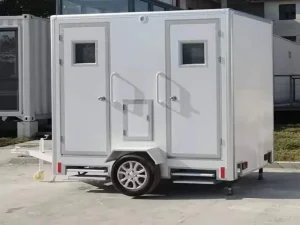
| Shipping Density (40HQ) | Up to 160 Units (Flat-Packed) | 40 – 50 Units Max | 2 – 4 Complete Units |
| Assembly Time | < 3 Minutes (1 Operator) | Instant (Pre-Assembled) | Instant (Towel Hitch Required) |
| Frame Material | Galvanized Steel + Polymer Panel | Single-Wall HDPE Injection | Heavy-Duty Steel Chassis |
| Wind Resistance Rating | Category 10 (Up to 100 km/h) | Category 5 (Needs Anchoring) | Category 12 (Stationary Mode) |
| Waste Tank Capacity | 200L - 350L Integrated / Direct Grid | 180L - 250L Standard Tank | 500L - 1200L Multi-Stall Tank |
| Service Life Expectancy | 12 - 15+ Years | 3 - 5 Years | 10 - 15 Years |
Enterprise buyers must navigate complex regional municipal regulations when importing and deploying mobile sanitation hardware. Qualified export suppliers adhere to international engineering standards, ensuring seamless integration with local public health guidelines.
Meets European Union requirements for mobile non-mains sewage portable toilets, ensuring specified ventilation ratios, minimum internal dimensions, and door locking safety mechanisms.
Available expanded folding configurations provide wheel-chair accessible wide-door clearance, zero-threshold entry ramps, and reinforced internal stainless-steel grab bars compliant with US ADA guidelines.
Engineered for sensitive environmental zones (national parks, coastal developments). Fully compatible with closed-loop solar water recycling and composting digestion modules.
The future of industrial portable toilet manufacturing lies in digital connectivity and automated fleet management. Leading manufacturers are embedding IoT sensor arrays into modular folding units to provide real-time operational telemetry for facility managers:
Optical sensors monitor tank capacity in real time, triggering automated service dispatches via cellular gateway before overfill conditions occur.
Internal short-wave UV-C LEDs automatically sanitize all interior surfaces between user cycles when integrated solar battery systems detect door closure.
Embedded low-power geofencing beacons assist rental fleet companies in tracking asset distribution across vast construction sites and event zones.