Choosing the right Steel Structure supplier is not a simple price comparison. It is a decision about safety, performance, documentation, and long-term project risk. A low quotation may hide weak welding controls, unclear material grades, or costly delays at the installation site.
The World Steel Association reported approximately 1.89 billion tonnes of crude steel production in 2023. This scale shows the industry’s strength, but it also reveals a difficult truth: not every supplier offers the same quality. AISC’s Steel Construction Manual and Specification for Structural Steel Buildings emphasize verified design, fabrication, inspection, and erection practices. These references provide a practical benchmark when reviewing a supplier’s technical capability.
Structural engineer Fazlur Rahman Khan once said, “Technical knowledge is not enough. One must also have the capacity to relate to people.” His observation remains valuable when selecting a supplier. A dependable company should explain load calculations, coating systems, bolt specifications, mill certificates, and inspection records in clear language. It should also provide realistic production schedules, factory photographs, project references, and evidence of quality management.
Look closely at the details. Can the supplier identify the steel grade on each certificate? Are welders qualified for the required process? Does the factory control dimensional tolerances before shipment? These questions matter more than polished brochures.
Experience helps, but it is not proof by itself. Even established suppliers can miss deadlines or communicate poorly. That uncomfortable possibility deserves attention. Compare technical documents, visit the facility when practical, and request independent inspection for critical components. A reliable Steel Structure supplier earns trust through measurable evidence, not confident promises.
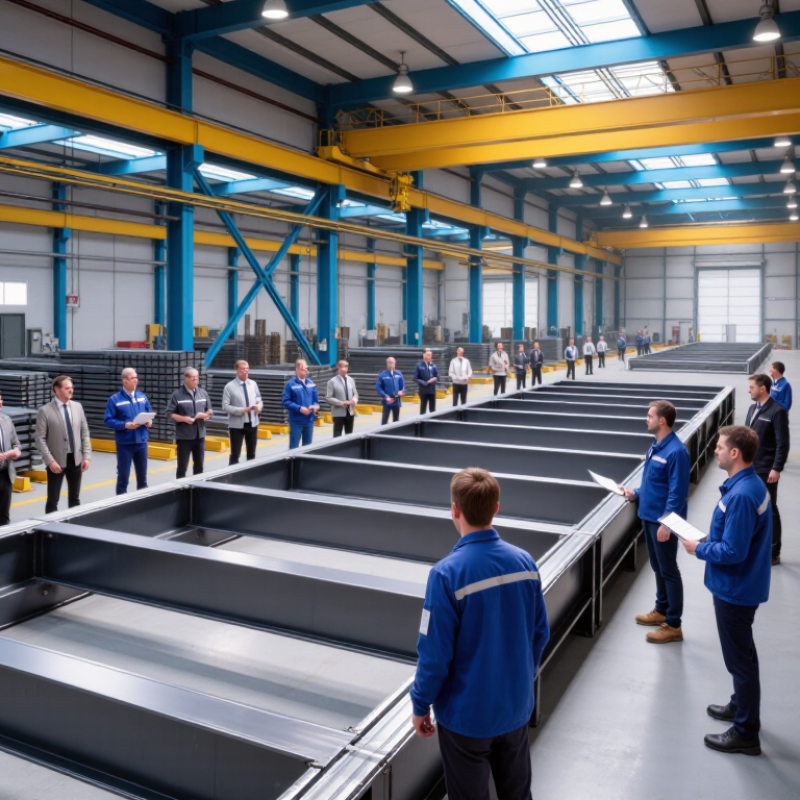
Before choosing a steel structure supplier, define the project in measurable terms. Record the building purpose, footprint, clear height, spans, column grid, and future expansion plans. Add roof loads, floor loads, wind exposure, seismic conditions, fire protection, and corrosion risks. A warehouse near the coast needs a different coating plan from an inland workshop. Details matter.
The World Steel Association reported approximately 1.89 billion tonnes of crude steel production worldwide in 2023. Construction remains one of the largest steel-consuming sectors, so material availability can affect lead times and pricing. Ask suppliers to identify steel grades, section sizes, fabrication tolerances, welding procedures, and inspection records. Request mill certificates and traceability documents. Do not guess.
Your requirement document should also state the governing design code, connection preferences, delivery limits, erection sequence, and acceptable substitutions. Include site photos, soil information, crane access, and local permit constraints. The 2024 Turner & Townsend International Construction Market Survey highlights continuing cost and supply uncertainty across construction markets. Therefore, compare suppliers by documented capacity, not only by quotation. A low price may exclude transport, testing, surface preparation, or temporary bracing. I have seen tidy schedules fail when unloading space was never checked. A better specification leaves room for questions, because some assumptions will be wrong.
Minimum yield strength of common structural steel grades for nominal thicknesses up to 16 mm, based on EN 10025 requirements. Use the required strength, thickness, toughness, welding method, and design code to evaluate whether a supplier can provide suitable material.
Choosing a steel structure supplier requires more than comparing prices. A reliable supplier should prove its qualifications, experience, and control over production. Request business licenses, professional certifications, and records from recent projects. Then verify these documents through issuing bodies or independent references.
Experience becomes visible in details. Ask for completed projects similar to yours in size, climate, loading, and construction method. Review drawings, connection designs, welding procedures, and inspection reports. A qualified team should explain material grades, design loads, tolerances, and corrosion protection without hiding behind technical language. Visit the factory if possible. Check steel storage, cutting equipment, welding areas, and traceability labels. Small details matter.
Industry standards must match the project location. Depending on the contract, relevant requirements may include structural steel, welding, quality management, and local building standards. Confirm that engineers hold appropriate credentials and that welders have valid qualifications. Ask how the supplier handles nonconforming materials, design changes, and final inspections. These answers reveal reliability better than a polished brochure. Brochures can mislead. Certificates may also be outdated.
Request a written inspection and testing plan before production begins. It should identify hold points, dimensional checks, coating thickness, and nondestructive testing. Independent inspection can add confidence, especially for critical connections. Still, no supplier is perfect. A factory may have strong equipment but weak communication. Another may have excellent engineers but inconsistent delivery records. Compare evidence, not promises, and record every unresolved concern before signing.
Choosing the right steel structure supplier requires more than comparing prices. Material quality should be verified through mill test reports, heat numbers, and clearly stated steel grades. Ask how each component is traced from delivery to fabrication. Check coating thickness, weld quality, bolt grades, and inspection records. A clean workshop helps, but documents matter more.
Design services should connect engineering decisions with real site conditions. Experienced teams review soil reports, wind loads, snow loads, crane requirements, and installation access before drawing the frame. Request sample calculations and revision records. Vague answers can create expensive changes later. I once trusted a neat drawing too quickly, and the missing drainage detail caused avoidable site work. That mistake still influences my supplier checks.
Tips: Ask for a design responsibility matrix. Confirm which standards guide the calculations. Visit the factory if possible, and watch how plates are marked, cut, welded, and inspected. Production capacity also deserves evidence. Review monthly output, equipment limits, quality staff, and current project schedules. A supplier may promise a short lead time, yet crowded workshops often delay painting or dispatch. Request a realistic production plan with inspection points and packing details. Small inconsistencies deserve attention. Reliability is visible in repeated records, not confident promises.
| Evaluation Dimension | Weight | Verification Standard or Benchmark | Supplier 1 | Supplier 2 | Supplier 3 | Supplier 4 |
|---|---|---|---|---|---|---|
| Material Grade and Traceability | 20% | Mill certificates, heat-number tracking, and compliance with S355 or ASTM A572 Grade 50 requirements. | S355 and ASTM A572 Grade 50 100% heat-number tracking |
S355 Batch-level tracking |
ASTM A572 Grade 50 Heat certificates available |
Grade specified by project Partial traceability |
| Material Testing and Inspection | 10% | Documented chemical and mechanical test reports, dimensional checks, and third-party inspection access. | Chemical and tensile reports Third-party inspection accepted |
Standard mill reports Internal inspection |
Mill reports and independent NDT Inspection hold points |
Basic mill reports Limited external inspection |
| Welding Qualification | 15% | Qualified welding procedures and certified welders in accordance with AWS D1.1, EN 1090, or equivalent requirements. | AWS D1.1 and EN 1090 procedures Certified welders |
Qualified procedures Welder certificates available |
AWS D1.1 procedures Continuous welder qualification control |
Project-specific procedures Documentation varies |
| Quality Management System | 10% | Current ISO 9001 certification, nonconformance reporting, corrective action, and final inspection records. | ISO 9001 system Digital inspection records |
ISO 9001 system Paper and digital records |
ISO 9001 system Formal corrective-action process |
Internal quality procedures Certification evidence pending |
| Structural Design Capability | 12% | In-house structural engineers, load calculations, connection design, shop drawings, and design-code competency. | In-house engineering team Connection and load design included |
In-house detailing team Engineering partly outsourced |
Full structural design service Multi-code capability |
Shop drawings only Client design required |
| BIM and Technical Coordination | 5% | Ability to deliver coordinated models, clash detection, fabrication drawings, and revision-controlled documents. | BIM coordination available IFC and native model formats |
3D detailing available Basic clash checking |
BIM model and clash reports Structured revision control |
2D CAD drawings Limited BIM support |
| Production Capacity | 10% | Annual fabrication capacity, workshop area, lifting capability, and ability to manage peak project volume. | Approximately 25,000 tonnes/year Dedicated assembly and coating zones |
Approximately 12,000 tonnes/year Flexible production lines |
Approximately 30,000 tonnes/year Multiple fabrication bays |
Approximately 8,000 tonnes/year Suitable for smaller projects |
| Fabrication Accuracy and Equipment | 5% | CNC cutting, automated drilling, controlled assembly, dimensional inspection, and calibrated measuring equipment. | CNC cutting and drilling Automated beam processing |
CNC cutting Semi-automated drilling |
CNC fabrication lines Laser measurement equipment |
Conventional equipment Manual dimensional checks |
| Surface Treatment and Corrosion Protection | 5% | Surface preparation grade, coating-system documentation, dry-film-thickness records, and galvanized or painted options. | Shot blasting to Sa 2.5 Coating thickness records |
Mechanical preparation and painting Standard inspection records |
Sa 2.5 blasting and duplex systems Independent coating inspection available |
Basic painting service Limited coating documentation |
| Typical Production Lead Time | 3% | Time from approved drawings and material release to completion of fabrication, excluding shipping. | 8–12 weeks | 10–14 weeks | 7–11 weeks | 12–16 weeks |
| Documentation and After-Sales Support | 5% | As-built drawings, packing lists, material certificates, inspection dossiers, installation support, and response time. | Complete inspection dossier Remote installation support |
Standard handover package Commercial support available |
Detailed turnover package On-site technical support options |
Basic handover documents Limited technical support |
| Weighted Evaluation Score | 100% | Suggested scoring method: Excellent = 5, Good = 4, Moderate = 3. Confirm all claims through audits, certificates, samples, and project references. | 4.75 / 5.00 | 3.95 / 5.00 | 4.85 / 5.00 | 3.10 / 5.00 |
Choosing a steel structure supplier requires more than comparing the lowest quoted figure. Ask for a line-by-line price covering steel grade, coating, fabrication, packaging, transport, and site support. A cheap offer may exclude lifting plans or connection details. Request recent project evidence, inspection records, and references from clients with similar building loads. This shows practical experience, not polished sales language.
The contract should define drawings, tolerances, approved substitutions, payment stages, and responsibility for delays. Include measurable acceptance criteria, such as coating thickness and bolt documentation. Do not accept “on-time delivery” without dates for fabrication, dispatch, and arrival.
Clarify what happens when weather, port congestion, or design changes interrupt the schedule. I have seen schedules fail because one missing drawing stopped an entire shipment. That risk deserves a written remedy.
Compare delivery plans against production capacity and transport routes, not promises alone. A reliable supplier should provide progress updates, packing lists, and tracking evidence.
Warranty terms need equal attention. Check coverage periods, corrosion exclusions, repair duties, and claim response times.
Ask whether warranty protection depends on installation records or maintenance inspections. Some terms look strong but become vague during disputes. Read every exception carefully, and ask an engineer to review unclear technical language.
I would also leave room for negotiation; rigid terms may hide assumptions neither party has tested.
Choosing a steel structure supplier requires more than comparing quotations. Communication often reveals project discipline. The Project Management Institute reported that ineffective communication puts 56% of project investment at risk. Ask how quickly the supplier answers technical questions, records revisions, and reports delays. Request a sample progress update, not a polished promise. Clear drawings, dated approvals, and one responsible contact can prevent costly misunderstandings. Silence is a warning sign.
Installation support deserves equal attention. A reliable supplier should provide erection drawings, bolt schedules, lifting guidance, and remote technical assistance. During installation, small details matter: a missing connection plate can stop a crane crew for hours.
The Construction Industry Institute has repeatedly linked reliable planning and field coordination with stronger construction performance. However, documents alone are insufficient. Ask whether supervisors have real site experience and whether support continues after the first delivery. My own view is simple: a supplier who disappears after shipment has not delivered a complete solution.
Long-term service should be measurable. Check warranty conditions, spare-part availability, inspection procedures, and response times. The ISO 9001 quality-management framework emphasizes documented processes, corrective action, and continual improvement. These practices help, but certification is not proof of excellent service. Speak with previous clients about corrosion repairs, modification requests, and communication after handover. Autodesk and FMI’s 2020 industry report estimated that poor-quality data cost construction globally 14.5% of annual revenue. That figure deserves reflection. If a supplier cannot maintain accurate records, future maintenance may become unnecessarily expensive. A strong partner remains reachable years later.
Record the building purpose, footprint, clear height, spans, column grid, and expansion plans. Include roof loads, floor loads, wind, seismic conditions, fire protection, and corrosion risks. Details matter.
Request steel grades, mill certificates, heat numbers, traceability records, and fabrication tolerances. Check welding procedures, bolt grades, coating thickness, and inspection reports. Do not guess.
Soil data, crane access, unloading space, and local permits affect design and installation. Coastal sites may need stronger corrosion protection. A tidy schedule can still fail.
Ask for sample calculations, revision records, and a design responsibility matrix. Confirm the standards used for structural calculations. The drawings should reflect real site conditions.
Review monthly output, equipment limits, quality staffing, and current project schedules. Request a realistic production plan with inspection points and packing details. Promises are not evidence.
Look for dated approvals, clear drawings, quick technical responses, and one responsible contact. Ask for a sample progress update. Silence is a warning.
Request erection drawings, bolt schedules, lifting guidance, and technical assistance during assembly. Confirm whether supervisors have practical site experience. A missing connection plate can stop work for hours.
Check warranty terms, spare-part availability, inspection procedures, and response times. Speak with previous clients about repairs and later modifications. Certification helps, but it is not proof of excellent service.
Choosing the right Steel Structure supplier begins with clearly defining your project requirements, including the building’s purpose, size, design, budget, schedule, and local environmental conditions. A reliable supplier should have verified qualifications, relevant project experience, and a strong understanding of applicable industry standards. It is also important to assess the quality and traceability of raw materials, the supplier’s engineering and design capabilities, and its production capacity to ensure consistent results and timely completion.
Before making a decision, compare quotations carefully, paying attention to contract details, payment terms, delivery schedules, and warranty coverage rather than focusing only on the lowest price. Effective communication is essential throughout the project, from initial consultation to manufacturing and shipment. You should also confirm whether the supplier provides installation guidance, technical support, inspection assistance, and responsive after-sales service. A supplier that combines technical competence, transparent cooperation, dependable production, and long-term support can help reduce project risks and achieve a safe, durable, and cost-effective outcome.